
Ridge lots, river bluffs and big hardwoods
Tree Service in Knoxville, TN
Tree removal, pruning, stump grinding and storm cleanup for Knoxville yards, planned around slopes, tall poplars and the local pests that kill trees here.
- No-cost estimates at your property in Knoxville and Knox County
- Your quote, in writing, itemized by tree
- Cleanup plan agreed before work starts
Tree Work for a City Built on Ridges
Good tree service in Knoxville starts with the lay of the land. The city sits in the Great Appalachian Valley, in the long folds of the Ridge-and-Valley country, with Sharp's Ridge topping out at 1,391 feet and West Knoxville hilltops above 1,000 feet while the riverfront sits just over 800. Plenty of homes here are built on a slope, below a wooded bank or on a lot that falls away toward a creek. That changes how a tree comes down, where the brush can be chipped and how much rigging a job needs. Elite Tree Service Knoxville plans every removal, trim and stump around the ground it sits on, not only the size of the tree.
The trees that matter most here
Knox County yards are full of eastern hardwoods that grow fast and get big. Tulip poplar, Tennessee's state tree, commonly reaches 80 to 150 feet, and its wood is light and brittle, so long limbs and tall leaders over a roof deserve a look. Oaks, hickories, maples, black walnut, pines and hemlocks are common on wooded lots, and dogwoods fill the understory: Knoxville's Dogwood Arts Festival runs for 17 days each April, and the first Dogwood Arts Trail was laid out on Cherokee Boulevard in 1955. Bradford pears, planted heavily in subdivisions, grow narrow, weak forks that split in wind and ice, and the trees typically live less than 25 years.
Pests and diseases we watch for
Some of the tree trouble in East Tennessee is local in a very literal sense. In late July 2010, a well-established outbreak of thousand cankers disease was found in the Knoxville area, the first discovery inside the native range of black walnut. A walnut infected with it usually dies within two to three years of the first yellowing in its outer crown, and the disease has moved in infested walnut wood, which is why walnut logs from your yard should not travel. Emerald ash borer kills ash trees by tunneling under the bark and leaves D-shaped exit holes; USDA has released parasitoid wasps against it in Tennessee. Hemlock woolly adelgid shows up as cottony white egg sacs under hemlock branches, and pines stressed by drought can be hit by southern pine beetle, which leaves small, popcorn-like lumps of resin on the bark.
Storms, ice and wet ground
Knoxville averages about 52 inches of rain a year, with July the wettest month, so summer thunderstorms often arrive when soil is soaked and canopies are heavy with leaves. Snow is usually light (about 4.6 inches in a normal season), but it does not need to be deep to break trees. The 1993 Storm of the Century dropped 15 inches on Knoxville, and in January 2026 a winter storm with freezing rain left more than 250,000 Tennessee customers without power. Ice on a tulip poplar or Bradford pear is the classic recipe for split trunks and limbs on roofs.
Older neighborhoods and newer subdivisions
Knoxville's housing ranges from Queen Anne and Craftsman houses in streetcar-era neighborhoods like Fourth and Gill, Parkridge and Fort Sanders, to the 1920s and 1930s streets of Sequoyah Hills and Lindbergh Forest, to post-war ranch houses and newer subdivisions on the edges of the county. Old neighborhoods tend to have huge trees close to the house with little room to work. Newer ones tend to have trees left at the edge of a cleared lot, which often decline a few years after construction, and fast-growing yard trees planted too close to the house.
What every estimate includes
- A look at each tree for lean, deadwood, cracks, cavities, fungus and insect signs
- A check of what is below it: house, deck, driveway, fence, neighbor's property
- Slope, soft ground and the route equipment would take
- Overhead lines and whether the utility needs to make it safe first
- A note if the tree may stand in the street right-of-way
- What happens to the logs, brush, chips and stump
- A written price, line by line
Why Homeowners Call Elite Tree Service Knoxville
Ground checked as closely as the tree
Slope, soft soil and the route to the tree decide how a Knoxville job is rigged, so they are part of every estimate.
Local pests named, not guessed
We look for the signs of thousand cankers, emerald ash borer, hemlock woolly adelgid and pine beetle and tell you plainly what we see.
One line per tree
Your written quote prices each tree separately, so you can approve one removal now and save a trim for later.
Wood kept local
Walnut and ash wood stays close to home or goes to local disposal, since moving infested wood is how these problems spread.
Common Questions
How much does tree service cost in Knoxville?
It depends on the tree's height, its condition and how hard it is to reach. National guides from HomeGuide and Angi put most removals between about $200 and $2,000 and most trimming jobs between about $400 and $900, with large trees and difficult access running higher. A big tree on a steep Knoxville lot can cost more than a taller one on flat ground. We give a written price after seeing it.
Do I need a permit to cut down a tree on my own property in Knoxville?
For most single-family lots inside Knoxville, no city permit is needed to take down a tree that is fully on your own property: the private-property part of the city tree ordinance exempts parcels used for a single-family home or duplex. The rules change at the street. A tree on city property or in an improved right-of-way, including the treelawn between sidewalk and curb, is a public tree, and removing one needs written approval from the city's urban forester; topping public trees is not allowed. In historic overlays such as Fourth and Gill, design review generally does not cover landscaping that needs no building permit, but Historic Zoning Commission staff will advise if you ask. HOA covenants can add their own rules, and Knox County outside the city has its own offices.
My black walnut is yellowing at the top. Is it thousand cankers disease?
It could be, and Knoxville is where that disease was first found in black walnut's native range, in 2010. Yellowing and thinning in the outer crown is often the first visible sign, and infected trees usually die within two to three years. Other things also stress walnuts, so a close look at the bark and branches helps. If it does have to come down, keep the wood local.
When is the best time for tree trimming around Knoxville?
For most hardwoods, late winter while the tree is dormant is a good time: leaves are off, structure is easy to see and cuts have the whole spring to close. Dogwoods and other spring bloomers are often pruned right after they flower. Dead, broken or hanging limbs should come out whenever you notice them, especially before summer storm season.
Who removes a tree that fell on a power line?
Report it to the electric utility first; inside the city that is KUB, at (865) 524-2911. Stay well away from the tree and the wire. KUB clears its primary and shared lines, but if a tree or limb takes down the service line to your house, KUB's rules make clearing the tree the property owner's job, and damaged service equipment on the house has to be repaired before power is reconnected. Once the line is safe, we can take down the rest of the tree, cut up what is on the ground and clean up.
Will the City of Knoxville haul away brush from my tree work?
City crews collect household brush every two weeks from the first full week of March through the last full week of October, with pickup paused during fall leaf season. Brush goes next to the street, kept separate from trash, in a pile no larger than 6 by 6 by 6 feet, out by 7 a.m. on the Monday of your collection week. A whole removal usually makes far more than one pile, so most quotes include chipping and hauling. Your week is on the city's brush schedule page or through 311.
How do I find a good tree company near me in Knoxville?
Ask for a written quote that lists every tree, the cleanup and whether stumps are included. Ask the company to have its insurer send you a current certificate of liability and workers' compensation coverage. If you want a formal diagnosis or a written risk assessment, ask whether an ISA Certified Arborist will do it; you can check that credential on the International Society of Arboriculture's website.
Can you take down a tree on a steep slope?
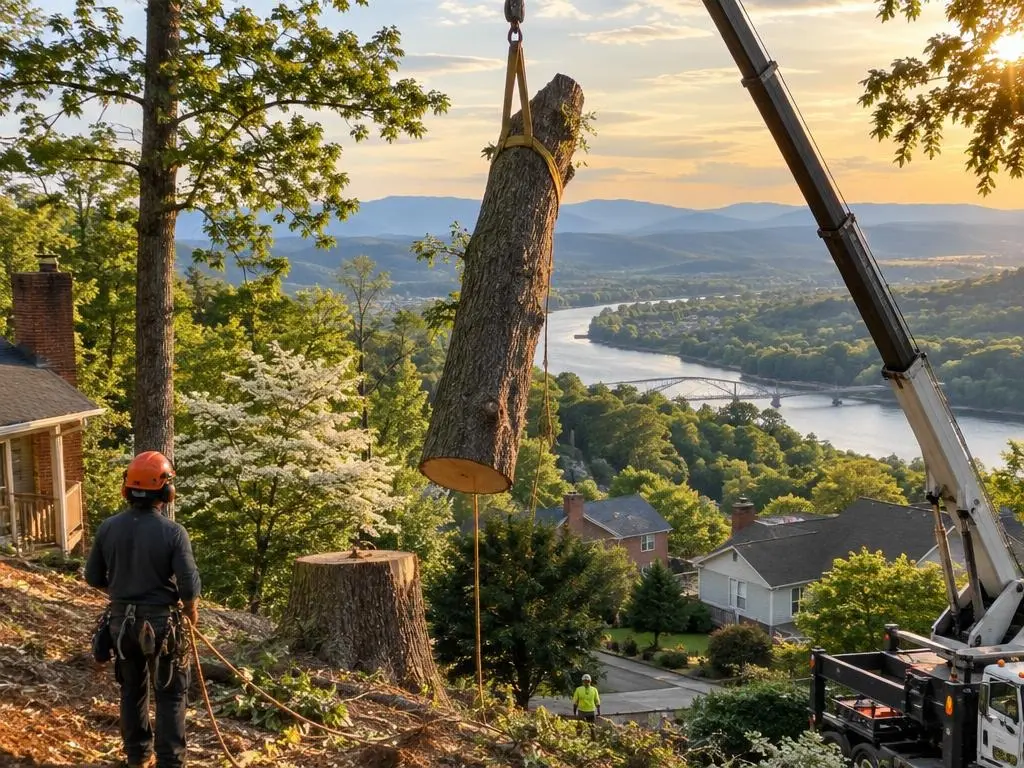
Yes. On hillside lots the tree usually comes down in pieces from the top, with limbs and wood lowered on ropes and moved uphill to the chipper by hand or winch. Where there is no safe way to rig a tree that leans over a house, a crane is sometimes the safest option. We explain the method in the quote.
Tree Services in Knoxville
Six kinds of work cover what Knoxville homeowners ask for most, from a single hanging limb to clearing a wooded lot for a build.
Tree Removal
Dead, leaning, diseased and oversized trees taken down in controlled sections, even on steep or cramped Knoxville lots.
Learn more →Tree Trimming & Pruning
Deadwood removal, crown thinning, roof and line clearance and young-tree pruning done to ANSI A300 standards, never topping.
Learn more →Stump Grinding
Stumps ground below the surface, surface roots chased out and the grindings left or hauled, including stumps on slopes.
Learn more →Emergency Storm Tree Service
Trees on roofs, cars and driveways cut free and cleared after Knoxville thunderstorms, wind and ice.
Learn more →Tree Health Assessments
A close look at a tree that worries you: decline, local pests like thousand cankers and hemlock woolly adelgid, and whether it is safe to keep.
Learn more →Land & Lot Clearing
Wooded lots, overgrown fence lines and building sites cleared of trees, brush and stumps, with keeper trees protected.
Learn more →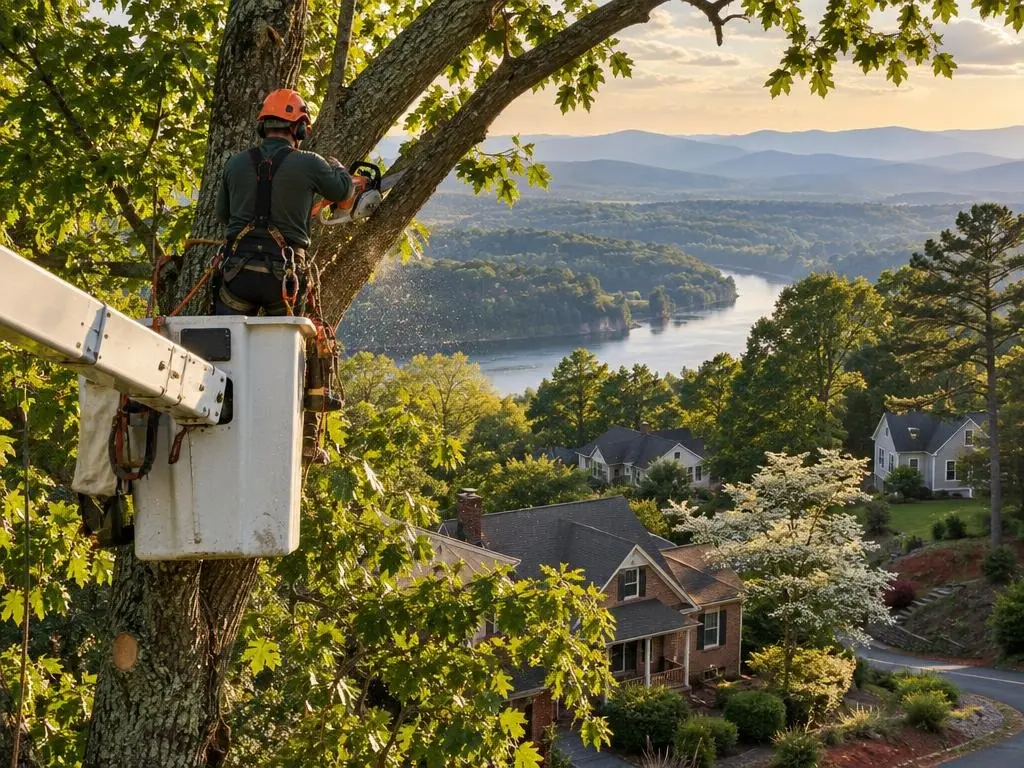
Where We Work
Knoxville is the center of the area we cover, and most of Knox County is within easy reach: Bearden, West Hills and Cedar Bluff in the west; Farragut, Concord and Hardin Valley farther out; Karns, Powell, Halls and Fountain City to the north; Holston Hills, Strawberry Plains and Corryton to the east; and South Knoxville, Island Home Park and the hills toward Kimberlin Heights across the river. The western suburbs tend to have newer subdivisions and trees left from the old woods; North Knoxville has older lots on ridge slopes; South Knoxville has steep, wooded ground near the river. The town pages cover what we know about each place.
- Tree Service in Knoxville, TN
- Tree Service in Farragut, TN
- Tree Service in Maryville, TN
- Tree Service in Alcoa, TN
- Tree Service in Oak Ridge, TN
- Tree Service in Powell, TN
- Tree Service in Halls Crossroads, TN
- Tree Service in Seymour, TN
- Tree Service in Lenoir City, TN
- Tree Service in Loudon, TN
- Tree Service in Clinton, TN
- Tree Service in Norris, TN
- Tree Service in Rockford, TN
- Tree Service in Louisville, TN
- Tree Service in Friendsville, TN
- Tree Service in Sevierville, TN
- Tree Service in Mascot, TN
- Tree Service in Karns, TN
- Tree Service in Fountain City, TN
- Tree Service in Bearden, TN
- Tree Service in Oliver Springs, TN
- Tree Service in Rocky Top, TN
- Tree Service in Jefferson City, TN
- Tree Service in Strawberry Plains, TN
- Tree Service in Corryton, TN
- Tree Service in Tellico Village, TN
- Tree Service in Sequoyah Hills, TN
Talk to Us About Your Trees
Free on-site estimates in Knoxville and across Knox County.